

The festival of Purim holds deep significance in Jewish tradition. It celebrates the triumph over good evil, and has inspired unique traditions, foods and customs in Jewish communities around the world.
From the delicious Purim treats to the heartfelt acts of giving Mishloach manot and gifts to the poor, read on to discover more about this joyous Jewish holiday.
Or if you just want all the Purim recipes, click here!

What is Purim?
Purim is an annual Jewish festival, which is held in the Spring. It celebrates the survival of the Jewish people, and the downfall of those who wish to harm us. It commemorates the events recorded in Megillat Esther – the Book of Esther. We recount how, in Ancient Persia, Esther (and her uncle Mordechai) saved the Jewish people from annihilation at the hands of King Achashverosh’s wicked advisor Haman.

Why is Purim important?
Although Purim is a minor festival in the Jewish calendar, it holds particular significance as unfortunately, antisemitism and persecution are still with us, over 2000 years since Mordechai and Esther. Purim provides an annual reminder that Jewish life continues, and those who wish us harm will ultimately get their comeuppance.
Purim is also an opportunity for us to poke fun at our oppressors, and to meet their hostility with joy and laughter. We rejoice in the triumph of good over evil. Purim reminds us that even in the darkest times, better times are coming.

What is the meaning of “Purim”?
The word Purim literally means ‘lots’. This refers to the drawing of lots undertaken by Haman to choose the date on which the Jews would be massacred.
When is Purim celebrated?
We commemorate the salvation of the Jewish people on the day after the date that Haman chose. Therefore Purim occurs on the 14th of the Jewish month of Adar, which usually falls sometime in March.
You can use Hebcal to find accurate dates of when to celebrate Purim.
According to the book of Esther, the events of the Purim story were not concluded in the Persian city of Shushan for a further day. Consequently, Purim is celebrated on the 15th of Adar in cities that historically had surrounding walls, such as Jerusalem. This is known as Shushan Purim.

How is Purim celebrated? – Traditions and customs
There are many and varied Purim traditions and customs in Jewish communities around the world. However there are four essential activities which we are supposed to take part in on Purim. They are:
Listening to a reading of Megillat Esther – the Book of Esther – which tells the Purim story
Megillat Esther recalls how Esther, a young Jewish girl, married King Achashverosh, in ancient Persia. As a result, she was able to save the Jewish people from the plans of the King’s evil advisor Haman, who sought to destroy all the Jews. Esther and her wise Uncle Mordechai are the heroes of the tale, who turn the tables on the wicked Haman and bring about his downfall.
The Megilla is read twice, once on the evening of the festival and then again the next day. The reading is usually accompanied by raucous boos and shouts and the clatter of groggers and noise-makers. These drown out Haman’s name each time it arises.

It is in the Joods Historisch Museum in Amsterdam.
Giving Mishloach Manot gifts
We are obliged to give Mishloach manot (משלוח מנות) – gifts containing at least two ready-to-eat foods or drinks – to at least one person. However typically people give more than one, taking the opportunity to treat their friends to something delicious! You should deliver your Mishloach manot on the day of Purim so that the contents can be enjoyed as part of the festivities. These fabulous food gifts are one of the most popular and enduring Purim traditions.
You can read my guide to assembling Mishloach Manot, here.

Giving Matanot La’evyonim – gifts to the poor
Emphasising the communal nature of the Purim celebration, we give Matanot La’evyonim (מתנות לאביונים) – gifts to the poor – to enable everyone to properly celebrate the festival.
Usually, it’s possible to make donations to Jewish food banks or similar charities in advance of the festival. These organisations are then able to distribute food and other items on the day of Purim, to ensure that everyone is included in the celebratory feast.
Donate to Leket, and give matanot le’evyonim in Israel, by clicking here.
Support the L’Chaim kosher foodbank in Manchester, by clicking here.
Give matanot le’evyonim via the United Synagogue, by clicking here.
Partaking in the Purim Seudah
The Purim seudah is a joyful feast held on the afternoon of the festival. The meal often features traditional foods and is an opportunity to bring families and friends together in celebration. Some people also have a custom to get drunk on Purim! This is one of very few times in Jewish tradition when drinking excessively is condoned or even encouraged.
If you’re wondering what to serve, you can browse all of my Purim recipes, here.

Celebrating Purim with fancy dress costumes
There is also a widespread custom of dressing up in costumes on Purim, leading to this festival sometimes being described as ‘Jewish Halloween’! This Purim tradition is said to have started in Italy in the fifteenth century, inspired by the masked entertainers of the commedia dell’arte.
Disguising ourselves in costumes reminds us of how G-d is disguised in the Purim story and does not explicitly appear. Some also say that wearing fancy dress symbolises the ‘topsy turvy’ nature of events in the Purim story, leading to the ultimate triumph of good over evil.

All of these customs and traditions help to create the uplifting and celebratory atmosphere for which the festival of Purim is well known. Each one adds another dimension to the celebrations.
Celebrating Purim around the world
Although there are some unifying traditions, such as those listed above, Jewish communities around the world also celebrate Purim in their own unique ways. There is a beautiful diversity of traditions across different communities, all part of the rich tapestry of Jewish culture. Some examples of current and past traditions include:
- Elaborate costume parties and Purim parades in the USA.
Jewish schools may present prizes for the best costume in this annual event. - Purim spielen – comedic Purim plays, often performed by children, are popular across Ashkenazi Jewish communities, including here in the UK.
- In North African communities, children make effigies of Haman to burn on a bonfire (much like a Jewish version of Guy Fawkes!).
Similar practices also took place in Yemen, Iran and other Middle Eastern countries. - Iranian Jews would make a pilgrimage to the tombs of Mordechai and Esther in Hamadan, in Western Iran.
- Bukharan Jews would make models of Haman out of snow, then melt them by lighting fires. The ‘snow-Hamans‘ were deliberately ugly and featured design elements chosen to mock the Purim villain.

These global celebrations highlight the universal appeal of Purim and its enduring significance to Jews worldwide. Each community put its own local spin on the festivities while still honouring the essence of the holiday.

Photo by Nick Taylor CC 2.0 via Wikimedia Commons
Special Purim foods
Purim is also a time to indulge in delicious festival treats and special symbolic foods. Hamantaschen – triangular filled pastries said to resemble Haman’s ears or hat, are the most famous. However there are many more delicious Purim foods – both sweet and savoury – from all around the world.

Foods that symbolise the defeat of Haman
In many cases, Purim foods are named after one or other of Haman’s body parts – or in some cases his entire body! As we enjoy our Purim treats, our enemy is destroyed utterly.
Some examples of these kinds of dishes include:
- Orecchie di Amman – sweet Italian fried pastries or ‘Haman’s ears’.
- Ojos de Haman – this Moroccan Purim bread is baked around a hard boiled egg to create ‘Haman’s eyes’.
- Caveos di Aman – a savoury noodle dish from Bulgaria made to resemble Haman’s flea-ridden hair (eugh!).
- Lebkuchen Hamohns – tasty gingerbread versions of Haman (and his wife Zeresh) originating in Alsace.
- Haman’s fingers – delicious filo pastry rolls filled with nuts and spices, made in Greece and Turkey.
- Huevos de Haman – a hard-boiled egg wrapped in strips of dough that represents Haman in a jail cell, eaten by the Jewish community of Rhodes.


Hamantaschen – delicious variations
British hamantaschen are traditionally made with a yeasted dough. However in the USA and other places, bakers use a short cookie-like dough or pastry to enclose the filing. The classic filling for both types of hamantaschen is a sweet poppyseed mixture, but you can use any sweet filling you like. Jams and preserves, chocolate, halva, biscoff, and all manner of different spreads have happily found their way inside a tasty hamantaschen!

It is also possible to make savoury hamantaschen. Whether filled with cheese and tomato to make pizza hamantaschen, tasty vegetables to make a pasty-style hamantaschen, or a curry-spiced mixture to make a samosa hamantaschen, they are always delicious! Your choice of filling is limited only by your imagination!
Here are some of my favourite variations on hamantaschen:


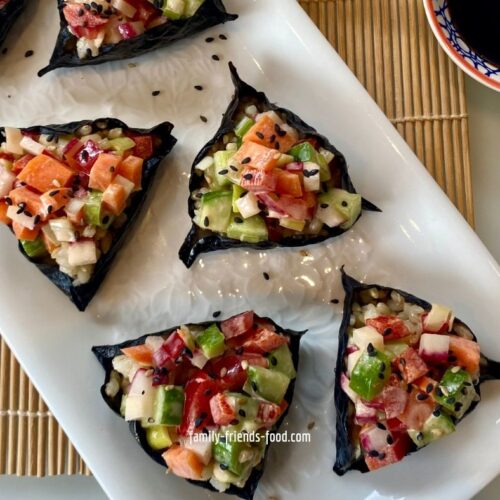

You can find more hamantaschen recipes here.
Foods commemorating Queen Esther
Legend has it that when Esther became queen and moved to live in the royal palace in Shushan, she ate only vegetarian food. This was so she could avoid consuming any non-kosher meat, or dishes that had not been prepared according to Jewish dietary laws. For this reason, some people have a tradition to make vegetarian foods, particularly those including beans and pulses, on Purim.
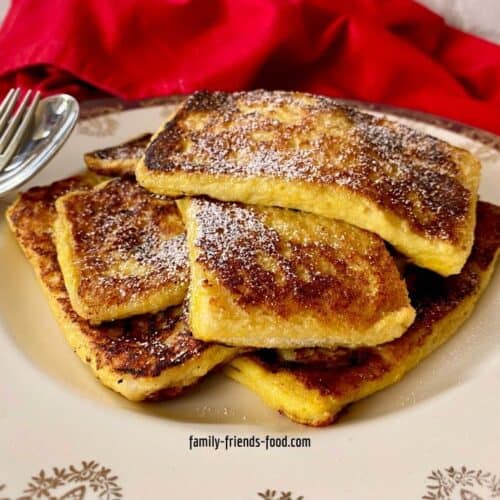
Revanadas de parida is a traditional Spanish Purim dish. A type of French toast, it is also known as Purim fritters or Queen Esther’s Toast.


Filled and stuffed foods
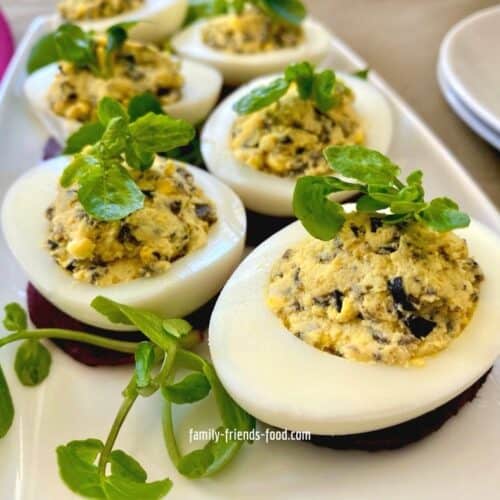
Both Ashkenazi and Sephardi Purim recipes include foods with a hidden or enclosed filling. This is said to represent the many secrets and surprises in the Purim story.


Mishloach manot – gifts of food and drink
One of my favourite Purim traditions is the giving (and receiving!) of Mishloach manot (משלוח מנות) – gifts of food and drink. They are sometimes also called mishloach manos, or shlach mones (שלח־מנות) in Yiddish, or simply referred to as Purim gifts or Purim baskets. Whatever you call them, exchanging these thoughtful gifts of tasty food and drink is a wonderful custom!

What you put in your Purim gifts is entirely up to you, as long as it includes at least two ready-to-consume items of food and/or drink. Popular items include homemade baked goods, juices, fruits, snacks, and confectionary. You can also assemble savoury mishloach manot gifts, using crackers, breads, dips, olives, cheeses or cartons of homemade soup or salad.
Read my guide to assembling terrific Mishloach Manot, here.
You may also like to theme your Purim gift baskets. Choose a cuisine, colour, activity etc and select foods that fit your chosen topic. In previous years I’ve made breakfast baskets, containing crumpets, marmalade, granola, tea bags etc. One year I created ‘Manchester’ themed gifts containing foods made in and around the city.
Giving and receiving Mishloach Manot helps to reinforce the spirit of community at the heart of Purim celebrations. We not only share delicious treats but also strengthen our friendships and enhance Jewish life as we celebrate together.

Wishing you a wonderful Purim!
The diverse traditions that we weave together in celebration of Purim are a powerful reminder of the triumph of good over evil. As we partake in the joyous festivities, enjoy the delicious Purim treats, and share in the spirit of celebration as a community, we also carry forward the message of Jewish resilience and hope.
Let us embrace this opportunity to spread joy! Let Purim be a reminder that unity and perseverance can overcome any obstacle.


Leave a Reply